
Season
When to see the pink water of the salt marshes
The Aigues-Mortes salt marshes are famous for their pink ponds, one of the most surprising landscapes in the Camargue. But the water is not pink all year round, nor at any time of day. To see this spectacle at its best, you need to choose the right season and the right moment. Here is everything you need to know to admire the pink water, understand the phenomenon and plan your visit.
Why is the water pink?
The pink colour comes from a micro-alga called Dunaliella salina and from tiny bacteria that live in very salty water. As the salt concentration rises, under the effect of the sun and wind, these organisms produce red and orange pigments, similar to those in carrots. The more the water evaporates, the saltier it gets, and the more intense the colour becomes. These organisms, and the small shrimps that feed on them, are also what give flamingos their colour.
The best season
The pink water is mostly visible in summer and early autumn, roughly from July to September. This is when it is hottest, when the water evaporates the most and when the salt concentration is highest. In spring, the colours are less striking. In winter, the harvest is over and the ponds look different.
The right time of day
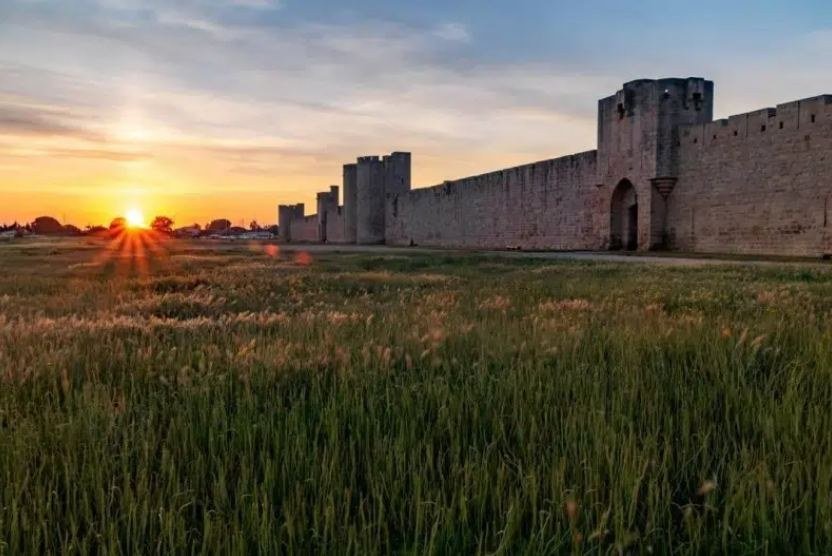
The colour looks most intense in full sunshine, when the light falls directly on the water. In the morning and late afternoon, the low light creates superb reflections, with shades of pink, orange and mauve. On cloudy days, the colours are duller. The wind can also change how the water looks.
The salt harvest
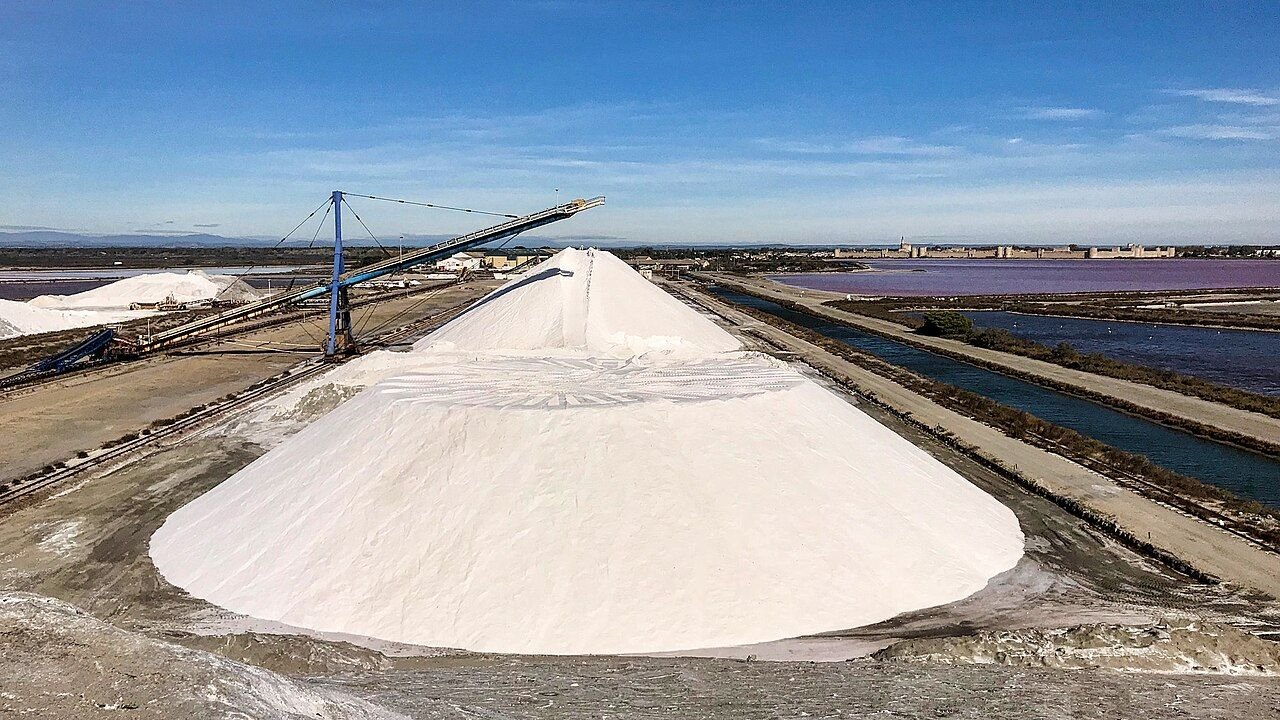
At the end of summer, usually late August and September, it is time for the salt harvest. Machines collect the salt deposited at the bottom of the ponds and form huge white mountains called camelles. The contrast between the white salt, the pink water and the blue sky is spectacular. Fleur de sel, finer, is harvested by hand from the surface of the water during the summer.
How to visit the salt marshes
The Aigues-Mortes salt marshes can be visited on guided tours, including by little train, which cover part of the site. A guide explains how salt is produced, the history of the salt marshes and the wildlife. Depending on the season, there are sometimes tours on foot, by bike or by 4x4. Tours are not free. In summer, book in advance, especially in July and August.
The flamingos
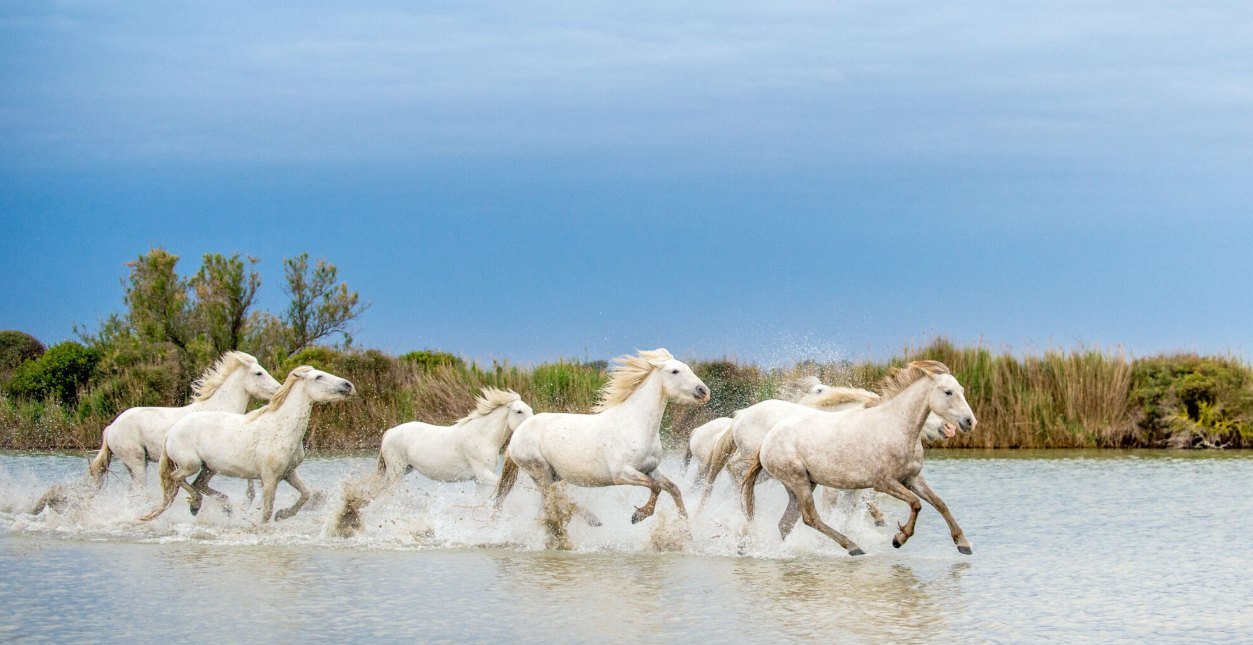
The salt marshes and nearby lagoons are home to many flamingos. They feed on the small shrimps that live in the salty water. During the tour, it is not unusual to see them up close. Their pink colour blends perfectly with the colour of the water.
Seeing the pink water without a tour
From some roads around Aigues-Mortes, and from the top of the ramparts, you can see pink ponds. But the salt marshes are a private, protected site: you cannot walk in freely. Respect the fences and signs. To really enjoy the spectacle, a guided tour remains the best option.
Our tips
- Come between July and September for the most intense colours.
- Book your tour in high season.
- Protect yourself from the sun: there is very little shade.
- Bring mosquito repellent for the end of the day.
- Take your camera: the colours are spectacular.
Fleur de sel, a souvenir to take home
The fleur de sel from the Aigues-Mortes salt marshes is renowned. Fine and delicate, it is sprinkled on dishes just before serving. You can find it in the salt marsh shop, at the markets and in the town's delicatessens. It is a light, useful souvenir, typical of the region.
Combine it with Aigues-Mortes
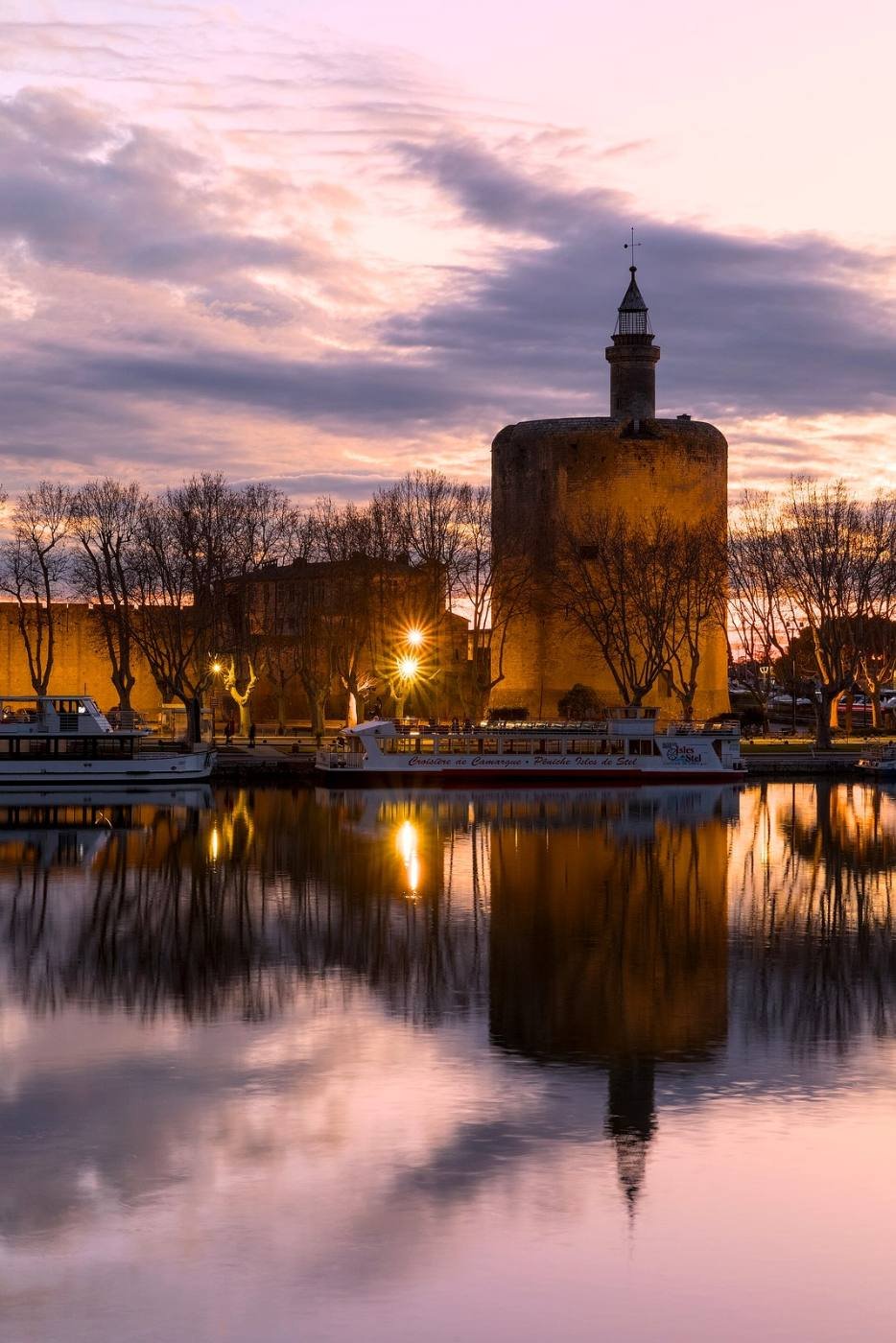
A visit to the salt marshes combines perfectly with the ramparts and the old town of Aigues-Mortes. In the morning, the ramparts while it is cool. At midday, lunch on Place Saint-Louis. In the afternoon, the salt marshes by little train. At the end of the day, a sunset at the Tour Carbonnière or on L'Espiguette beach.
The salt marshes, an ancient history
Salt has been harvested in the area since Antiquity. In the Middle Ages it was a great source of wealth: it was used to preserve meat and fish and sold at a high price. Even today, the Aigues-Mortes salt marshes are among the largest in the Mediterranean. The salt is used for food, but also for industry and for gritting roads in winter.
The salt marshes through the seasons
Each season shows a different side of the salt marshes. In spring, nature wakes up, migrating birds return and the basins begin to fill. In summer, evaporation speeds up under the sun and wind, the water becomes saltier and the pink grows more intense day after day. At the end of summer and the beginning of autumn, it is harvest time, with machines crisscrossing the salt pans and the salt mountains growing. In winter, the salt marshes become calm again, the colours softer, and flamingos remain numerous on the nearby lagoons. There is no bad season to come: just different atmospheres.
The "camelles", mountains of white salt
After the harvest, the salt is gathered into huge white heaps called "camelles". These real mountains of salt, which can reach the height of a building, rise in the middle of the Camargue plain and contrast strikingly with the pink of the basins and the blue of the sky. They are among the most famous images of the Aigues-Mortes salt marshes. During guided tours, you can often get close to them and enjoy the view over the salt pans and the ramparts in the distance.
Taking great photos of the salt marshes
The pink salt marshes are one of the most photographed subjects in the region, and for good reason: the colours are spectacular. A few tips for great pictures:
- Choose the right light: in the morning and late afternoon, the low light brings out the shades of pink and softens the contrasts.
- Look for reflections: on calm days, without wind, the basins become real mirrors.
- Play with lines: the dykes, canals and salt mountains create graphic lines that structure the image.
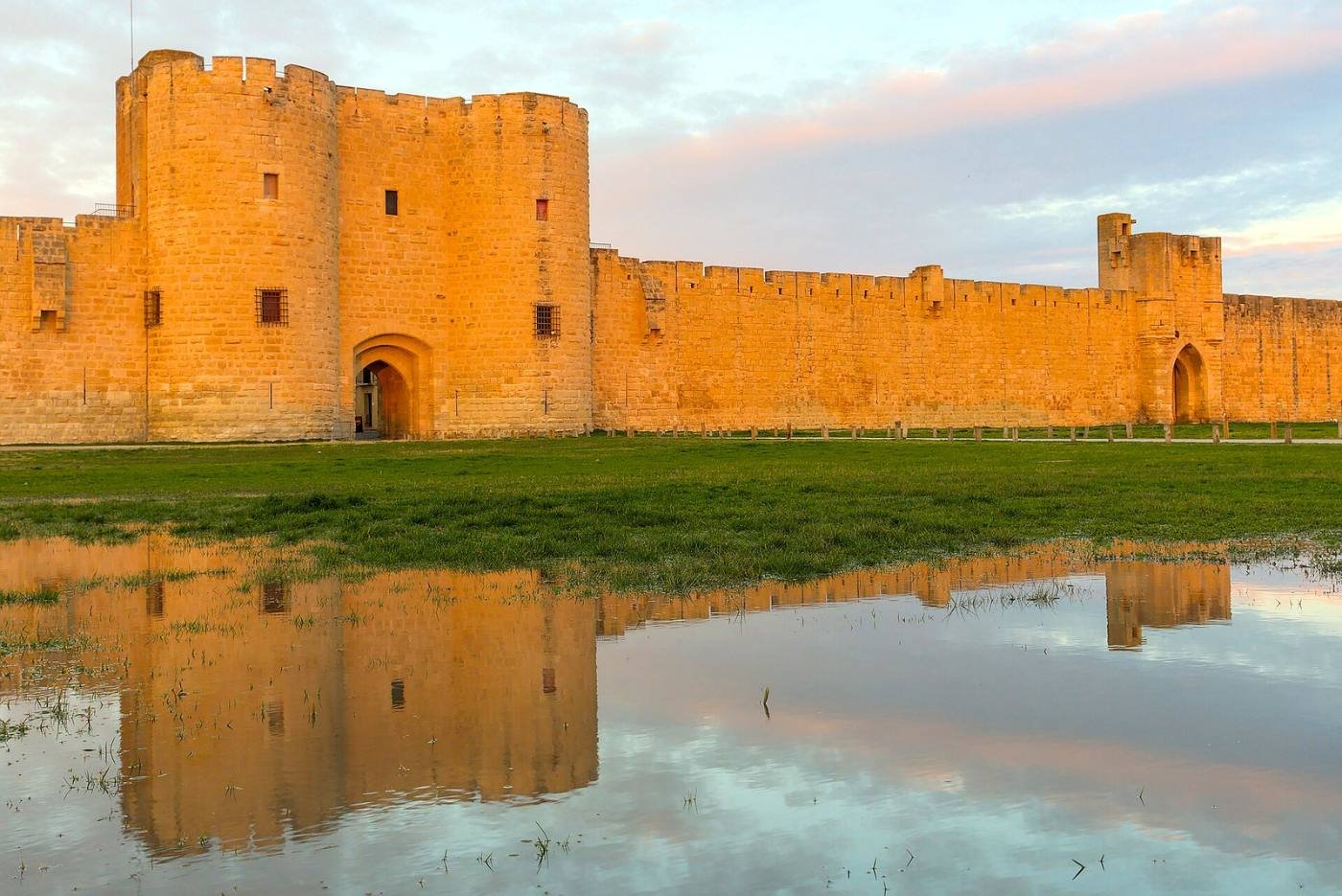
- Include the ramparts: from some viewpoints, the outline of Aigues-Mortes stands out on the horizon behind the pink basins.
- Be patient with the flamingos: a telephoto lens or a good zoom is useful to photograph them without disturbing them.
- Respect the site: stay on the authorised paths and never go into the basins.
Wildlife and plants of the salt marshes
The salt marshes are not just a production site: they are also rich, protected natural areas. As well as flamingos, you can see elegant avocets, recognisable by their upturned bills, black-winged stilts with long pink legs, egrets, herons, gulls and many species of waders. In spring and autumn, migrating birds stop over in these wetlands, to the delight of birdwatchers.
Among the plants, samphire is the star. This small succulent, which grows in salty soil, can be eaten raw, in salads or pickled, and goes perfectly with fish and seafood. You can sometimes find it at the region's markets in summer. The "sansouïres", stretches of low salt-tolerant vegetation, turn red and purple in autumn.
Camargue salt in the kitchen
Salt from the Aigues-Mortes salt marshes is used in kitchens all over the world. Fleur de sel, harvested by hand from the surface of the basins, is kept for the final seasoning of dishes: a few crystals on a tomato, grilled fish, meat or even caramel are enough to bring out the flavours. Coarse salt is used for cooking pasta and vegetables, or for salt crusts, a technique that lets you cook a whole fish while keeping it tender. You can also find salts flavoured with herbes de Provence, Espelette pepper or seaweed, which make lovely gifts.
Planning your visit: mosquitoes, wind and sun
The Camargue is a land of marshes, and mosquitoes are plentiful, especially in summer and in the evening. Remember to bring an effective repellent and covering clothes for sunset. The wind, especially the mistral, can blow hard and make the walk cooler than you would expect: a light jacket is often useful, even in summer. On the other hand, on calm sunny days, the heat and the glare from the salt and water are intense. Sunglasses, a hat, sun cream and a bottle of water are essential.
Visiting the salt marshes with children
The salt marshes are an ideal outing for families. Children are fascinated by the colour of the water, the mountains of salt and the flamingos. The little train tour is particularly suitable for the youngest, as it covers long distances without tiring them out. Bring binoculars to watch the birds, and take the opportunity to explain how salt is formed by the sun and the wind. A shop often offers products and souvenirs that young and old will love.
Accessibility of the salt marshes
Some tour options, especially the little train, are accessible to people with reduced mobility or elderly people who cannot walk for long. Check the access conditions with the salt marshes in advance. Your driver drops you as close as possible to the reception and waits for you at the exit, avoiding long walks from a car park.
A day around the salt marshes
To make the most of the salt marshes and their surroundings, here is an idea for a day. In the morning, visit the ramparts of Aigues-Mortes before the heat, with a walk along the wall walk from which you can already see the pink basins south of the town. Late in the morning, a guided tour of the salt marshes by little train or bike, depending on the options available. Lunch in town, on a terrace on Place Saint-Louis. In the afternoon, a boat trip on the canals or a visit to a bull ranch. At the end of the day, back to the salt marshes to admire the colours at sunset, when the water takes on its most intense shades. Your driver can accompany you all day, as hourly hire, and drop you at each stop.
The other salt marshes of the Camargue
The Aigues-Mortes salt marshes are not the only ones in the region. On the other side of the Rhône, Salin-de-Giraud has other large salt works, in the heart of the Grande Camargue, with spectacular views of the basins and salt mountains. The road there crosses wild landscapes, between lagoons, rice fields and pastures. For a full day of discovery, your driver can combine the Aigues-Mortes salt marshes in the morning and Salin-de-Giraud in the afternoon, via Saintes-Maries-de-la-Mer.
Visiting the salt marshes without a car
The salt marshes are outside the centre of Aigues-Mortes and are not conveniently served by public transport. In summer, the car park at the reception can be very busy. With your driver, you are dropped right at the entrance and picked up at the end of your visit. From Le Grau-du-Roi, La Grande-Motte, Montpellier, Nîmes or Lunel, it is the simplest way to discover this exceptional site, without worrying about the route or parking.
Whatever the season you choose, the salt marshes leave a lasting impression. Book your driver and enjoy the visit without worrying about anything else.
To book your driver for the salt marshes, simply fill in the price request form at the top of this page or call us directly. You will receive a clear price on WhatsApp, with no obligation, and your driver will take care of everything on the day: punctual pick-up, help with your luggage, a smooth and comfortable journey, and drop-off right at your door. ChauffeurTourVIP, your private driver and affordable alternative to a taxi, available 24/7.
Getting there with a driver
With a driver, you reach the salt marshes without looking for a parking space, even in high summer. You are dropped off at the tour reception, your driver waits or comes back for you, then takes you to your next stop. A practical alternative to taxis at an affordable price, from Le Grau-du-Roi, La Grande-Motte, Montpellier or your campsite. Book on WhatsApp.